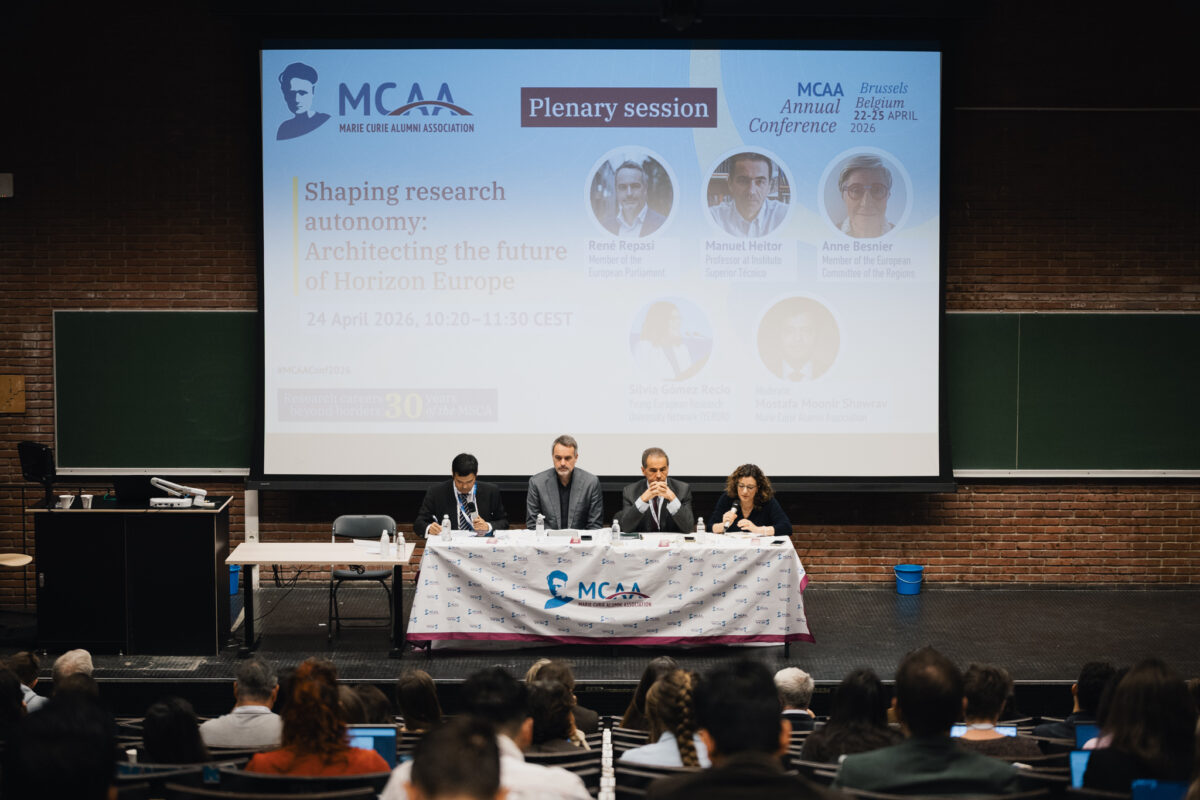
This article builds on the reflections shared at the MCAA Annual Conference 2026, during the session on doctoral training, skills and research careers, organised by the Marie Curie Alumni Association (MCAA) in Brussels.
By Silvia Gómez Recio, Secretary General, Young European Research Universities Network – YERUN
At a time when Europe is redefining its priorities around competitiveness, resilience and talent circulation, doctoral education is increasingly recognised as a strategic tool for strengthening Europe’s talent and skills base, innovation capacity and long-term societal impact.
These issues were at the heart of discussions at the latest MCAA Conference, held in Brussels on 22-24 April, where it became clear that doctoral education sits at the intersection of research, education, labour markets and innovation systems. Doctoral training is now expected to produce excellent research, prepare researchers for diverse careers, strengthen innovation capacity, and support mobility across sectors and borders. I was pleased to bring in the perspectives of YERUN members during a dedicated session on doctoral education and transferable skills.
From academic training to strategic capability
Doctoral candidates are a core part of Europe’s research and innovation workforce. They contribute directly to the production of new knowledge, technologies, and solutions, often acting as the bridge between fundamental research and real-world application. At the same time, the reality of doctoral careers has changed significantly: the majority of PhD graduates today build their careers outside academia, contributing to industry, public administration, healthcare systems, start-ups and civil society.
Universities across the YERUN network see this shift clearly. For instance, NOVA University Lisbon and Carlos III University of Madrid (UC3M), doctoral training is increasingly framed as a mechanism to strengthen innovation ecosystems and support broader societal transformation, equipping researchers not only with disciplinary expertise but also with the capacity to translate knowledge into impact.
In this context, doctoral education becomes a key pillar of Europe’s “Union of Skills”, contributing to talent development, knowledge circulation and competitiveness across sectors.
Bridging excellence and transferable skills
One of the central questions is not whether doctoral researchers need transferable skills, but how these can be meaningfully embedded within doctoral training without compromising research excellence.
Across Europe, there is broad recognition that skills such as communication, project management, entrepreneurship, teamwork and career development are essential. However, in practice, these are still too often treated as optional add-ons rather than integral components of the doctoral journey.
Experiences from YERUN members show that progress is possible when universities take a more structured approach. For example, the University of Antwerp’s Doctoral School provides Personal Development Plans that explicitly combine research development with broader competencies, supporting researchers’ self-awareness, career development and wellbeing. Similarly, initiatives such as the YUFE DIOSI model for Doctoral Training place doctoral candidates at the center of a framework that integrates research, skills development, cross-sectoral mentoring and self-reflection.
These approaches illustrate an important shift: from offering training opportunities to designing coherent doctoral pathways where research and skills development are interconnected.
The importance of coordination and institutional support
A recurring theme across institutions is the importance of coordination. Doctoral training often sits at the intersection of multiple units—faculties, doctoral schools, career services, and research offices. When these elements are aligned, universities can offer more coherent and effective support.
Conversely, when responsibilities are fragmented, doctoral researchers may experience uneven access to opportunities or unclear guidelines.
Several YERUN members are therefore strengthening the role of doctoral schools or central coordination structures to bring these elements together. This does not mean centralisation for its own sake but rather ensuring that doctoral researchers benefit from a clear, visible, and structured offer across the institution.
In practice, this can include linking research progress with skills development, integrating career planning into doctoral pathways, and ensuring that supervisors are supported in guiding researchers beyond the academic track.
Building strong ecosystems beyond academia
Connecting doctoral training to the wider world remains one of the most important,and most complex, dimensions.
Opportunities for intersectoral exposure, such as secondments, co-supervision or collaboration with external partners, are highly valuable but not always easy to implement. In some cases, universities operate in regions with fewer established partnerships, or external organisations may not yet have the structures to host doctoral researchers effectively.
Experiences shared within the YERUN network highlight that this is not simply a matter of willingness, but of building mature ecosystems over time. As noted by colleagues from the University of Konstanz, meaningful intersectoral experiences require partners that are prepared to engage and provide structured learning environments, rather than ad hoc placements.
Encouragingly, universities are increasingly addressing this by strengthening collaboration with regional partners, leveraging European alliances, and embedding intersectoral elements within research projects rather than treating them as external additions.
The role of mentorship and culture
Beyond structures and programmes, culture plays a decisive role. Supervisors and mentors are central to shaping doctoral experiences, influencing how researchers perceive career options and opportunities.
There is growing recognition that mentorship needs to evolve alongside doctoral education. Providing guidance on diverse career paths, supporting skills development, and encouraging intersectoral engagement require specific competencies that go beyond traditional academic supervision. Moreover, institutions play an important role on supervision and mentoring as key enablers, through setting the frameworks of supervision and ensuring that the necessary resources, services, support and recognition is provided to both doctoral reserachers and supervising teams.
Some YERUN members are already investing in this area, including mentor training, structured supervision frameworks, and the involvement of non-academic mentors (through an active engagement with alumni). Evidence from initiatives such as collective supervision at the University of South-Eastern Norway, supervision awards for supervisors who foster doctoral researchers’ growth at the University of Eastern Finland and those at the University of Antwerp shows that mentoring can significantly enhance researchers’ confidence, career clarity, and professional development.
Learning from the MSCA model
The MSCA offers a valuable reference point for how structured, international and intersectoral doctoral training can be delivered at scale. Its emphasis on mobility, interdisciplinary collaboration, transferable skills and exposure to non-academic sectors provides important lessons for institutional practice.
The challenge now is to translate these strengths into more sustainable models within universities, beyond the limits of project-based funding. This will require institutional commitment, but also supportive framework conditions at national and European level, recognising the full value of doctoral education and providing the resources needed to deliver it effectively.
Moving forward: from principles to practice
Doctoral education requires coordinated policy attention, sustainable funding, and systemic reform through evidence-based changes. It has evolved beyond its traditional role of preparing future academics and should now be recognised as a strategic pillar of Europe’s broader skills, research, and innovation agenda.
Europe has already established strong principles for doctoral education, from the Salzburg recommendations to the EU’s frameworks on innovative doctoral training. The key question now is how to translate these principles into consistent practice across institutions and systems.
From the perspective of research universities, several priorities emerge:
- Embedding transferable skills within doctoral programmes, rather than treating them as optional additions
- Strengthening coordination across institutional structures, ensuring coherent support for doctoral researchers
- Investing in mentorship and supervision capacity, including training for supervisors and institutional support
- Building sustainable partnerships beyond academia, supported by strong regional and European ecosystems
- Learning from successful models such as MSCA, while adapting them to institutional realities
Ultimately, the ambition is clear: to ensure that doctoral education fully reflects its strategic role in Europe’s future.
Doctoral education is not only about training researchers; it is about developing the people who will advance knowledge, strengthen innovation, inform policy, and contribute to society. Europe’s ability to compete, adapt and lead will depend on whether this talent is properly supported.
.
The author would like to extend her sincere gratitude to Catarina Ruivo (NOVA Doctors School, NOVA University Lisbon), Anamaria Gimeno (UC3M Doctoral School, Universidad Carlos III de Madrid), Ynte Vanderhoydonc (Antwerp Doctoral School, University of Antwerp), Anda Lohan (University of Konstanz), Goran Hauser (Rector, University of Rijeka), Marina Šantić (Vice-Rector for Science and Arts, University of Rijeka), and Nataša Jakominic Marot (Head of University Centre for Research and Innovation, University of Rijeka) for their valuable insights and contributions, which greatly enriched this intervention.