Artificial intelligence is rapidly transforming how universities conduct research, educate students, support their communities and organise their daily activities. From accelerating scientific discovery and enabling new forms of teaching and learning to improving institutional services, AI offers significant opportunities to strengthen universities’ contribution to society. At the same time, its growing use raises important questions about ethics, transparency, privacy, academic integrity, critical thinking and human responsibility.
For YERUN, artificial intelligence is therefore not simply a technological development, but a strategic issue that touches upon every dimension of the university mission. As young research universities, YERUN members are actively exploring how AI can be used critically, responsibly and innovatively, while ensuring that technological progress remains aligned with academic values and societal needs.
Across the network, universities are responding in different but complementary ways. Members are developing institutional policies and guidelines, establishing dedicated committees and task forces, investing in AI literacy and secure digital tools, adapting teaching and assessment practices, and advancing interdisciplinary research into both the applications and wider implications of AI. Although their institutional contexts and approaches vary, a shared principle emerges: AI should support and enhance human expertise, rather than replace human judgement and accountability.
In this article, YERUN members share how they are approaching artificial intelligence across research, education and university services. Together, their contributions illustrate the breadth of activity taking place across the network and highlight a common ambition: to harness the transformative potential of AI while helping shape a future in which its development and use are responsible, inclusive and centred on people and society.
Universidad Carlos III de Madrid
At Universidad Carlos III de Madrid (UC3M), we did not just watch the Generative AI revolution unfold: we decided to actively and critically get involved with it. Since 2023, UC3M has pioneered GenAI integration in teaching and learning, becoming one of the first Spanish universities to publish a comprehensive guide with tailored recommendations for both faculty and students.
Our institutional strategy kicked off with interdisciplinary working groups from the Faculty organized by knowledge areas. Intense brainstorming—spanning at least four meetings over four months—crystallized into some golden guidelines: mandatory usage declaration, safeguarding irreplaceable critical thinking, rethinking obsolete assessment methodologies, and the urgent need for universal training.
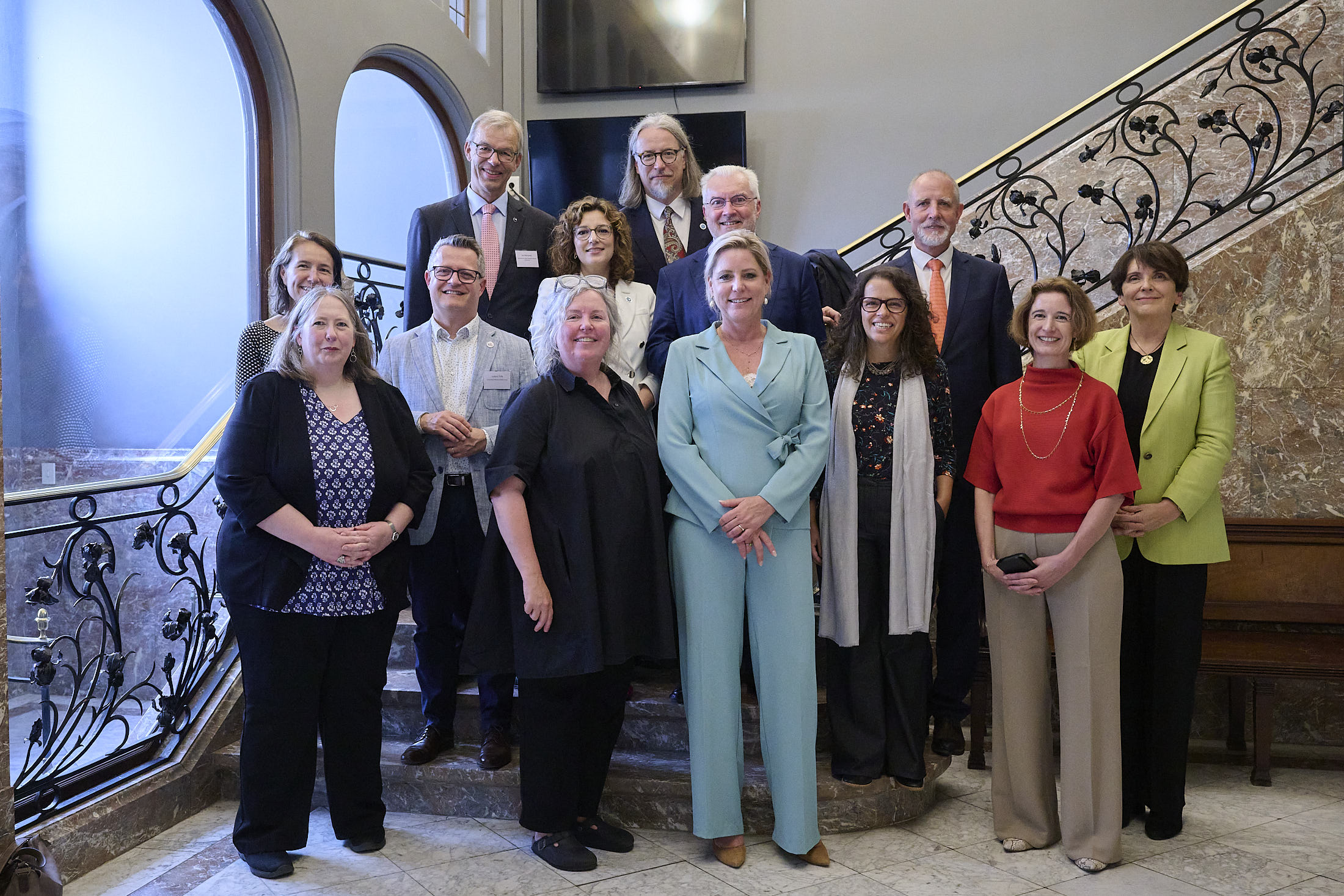
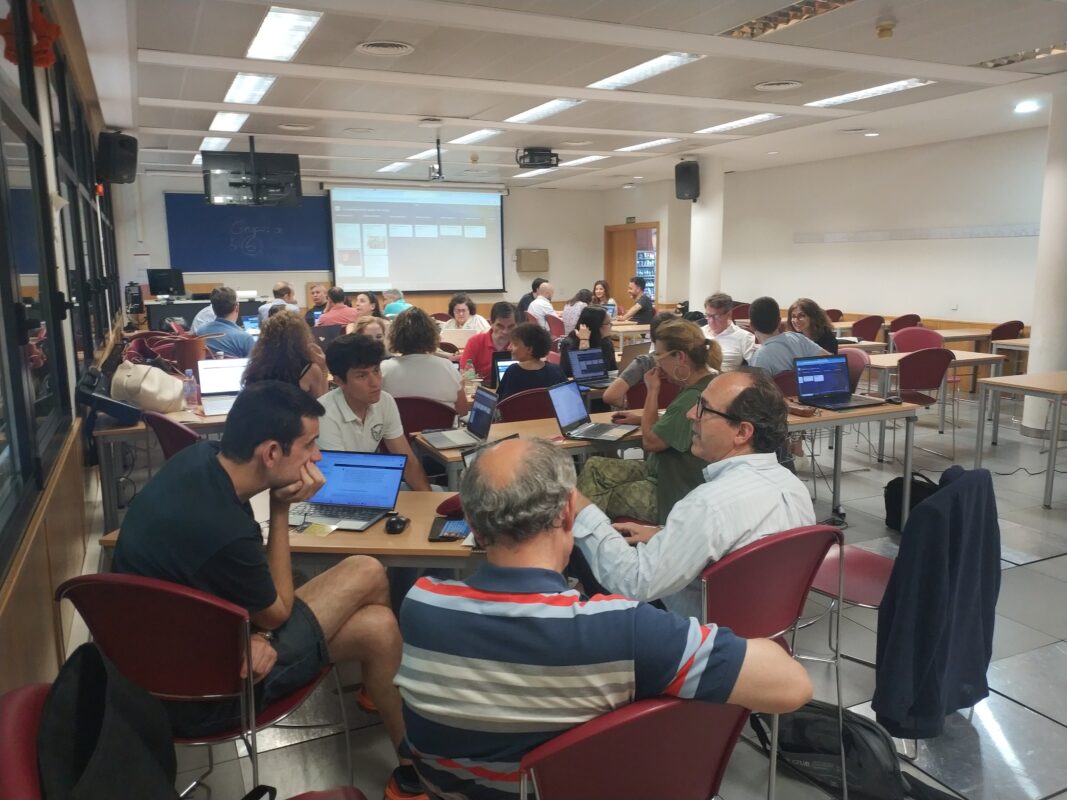
To bring these principles to life, we launched a robust, three steps training ecosystem in June 2024. This route scales from quick 1-hour basics to immersive 3-hour workshops -see photograph- addressing environmental impacts, ethical biases, AI tools and classroom integration, culminating in the creation of AI-centered teaching innovation communities. The payoff has been immense: over 500 faculty members—roughly 25% of our staff—have already been upskilled.
Students are equally crucial to this shift. GenAI literacy and ethical use are now embedded into a first-year transversal digital skills for Information -or for Engineering- subjects. Furthermore, a vibrant collaboration with the student association InnovAI sparked a creative social media campaign whose reels and videos have clocked over 150,000 views.
To maintain academic rigor, our Library Services worked with key Vice Rectorates to establish benchmark guidelines for declaring AI use in bachelor, master and doctoral theses. Meanwhile, administrative and support staff underwent a comprehensive, highly practical 9-hour course to master the AI tools available in the UC3M workspace.
Ultimately, we are thrilled to actively share this rich background and exchange milestones within the YERUN Ad-Hoc Group on AI in Teaching and Learning, eager to learn from our European colleagues. Let’s reshape the future of education together!
Raúl Aguilera – Head of Library Service
Ricardo Vergaz – Deputy Vicerector for UC3M Digital
University of Rijeka
Artificial intelligence (AI) is no longer just a scenario from science fiction movies. It is here, in our lives and workplaces, shaping the way we make decisions. It is a key driver of digital transformation that permeates every area of life and work. Although it brings numerous opportunities to improve the quality of life, global prosperity, and economic development, it is essential to emphasise the need for the responsible management and development of AI tools.

Recognising both the benefits and risks of using AI tools, the University of Rijeka advocates their responsible, ethical, open, transparent, and innovative use. In January 2024, the UNIRI Senate adopted the ‘AI Tools Usage Policy’ as the fundamental document governing the use of AI tools at the University of Rijeka.
In line with this Policy, in December 2025, the University also adopted ‘Guidelines for Responsible AI Tools Usage’, intended to provide practical instructions and examples of good practice that enable all stakeholders in the T&L process at the University of Rijeka to use AI tools responsibly. In four sections – use of AI tools in the teaching process, transparency and academic integrity, ethics and responsibility, and the balance between digital and non-digital activities – the guidelines offer practical advice to researchers, teachers, and students on the responsible use of AI, without restricting innovation.
To bridge the gap between science and society and translate complex formulas into easy-to-read instructions, the guidelines conclude with five simple tips for the responsible use of generative AI: 1) be transparent, 2) develop digital competencies, 3) use AI as an auxiliary tool, 4) protect privacy, and 5) critically evaluate content. The guidelines are regularly revised to ensure they remain aligned with the current state of technological advances and educational needs.
University of Cyprus
The University of Cyprus is integrating Artificial Intelligence (AI) through a structured institutional approach that combines governance, guidance, awareness-raising, research, innovation and dialogue. To support this work, the University has established a Committee on AI, with the mandate to guide the responsible, effective and innovative use of AI across teaching, learning, research and broader academic practice.

A key part of the Committee’s work has been the development of institutional guidelines. The first guidelines, implemented in the Fall Semester 2023–2024, focused on the use of AI in educational processes, providing an initial framework for teaching and learning. Building on this foundation, the Committee developed an updated version in 2025, expanding the scope to teaching, learning and research, with emphasis on academic integrity, transparency, critical thinking, privacy and accountability.
To support implementation, the Committee has also developed the University’s AI website, which provides resources for teaching staff, students and researchers. These include practical examples and “do’s and don’ts” that translate the guidelines into concrete academic practice. The University has also appointed Contact Points for AI, with one faculty member in each department acting as a link between the Committee and departmental communities.
The Committee further promotes dialogue and engagement through initiatives such as an annual AI seminar, the first issue of its AI newsletter in July 2026, and a university-wide student survey mapping AI use, perceptions, benefits, risks and support needs.
Beyond the Committee’s work, the University advances AI-related research and innovation through initiatives such as the XM Chair, further strengthening its engagement with AI and its applications.
University of Limerick
AI technologies offer significant opportunities to enhance teaching, learning, research, administration, and innovation. AI presents opportunities to support and transform many scenarios where intelligence is required. The impact of AI will be transformative and lead to new ways of working and learning. At the same time, they introduce risks and ethical challenges including implications for academic integrity, research integrity and public trust.
AI investment and use require care and informed consideration. For example, AI training is susceptible to deep social and data bias. This means that broader societal risks may also be amplified, including bias and discrimination, inequitable access, misinformation, and the erosion of privacy rights. Misuse and overreliance on AI systems may also undermine independent judgement, critical thinking, disciplinary expertise, and high-quality learning.
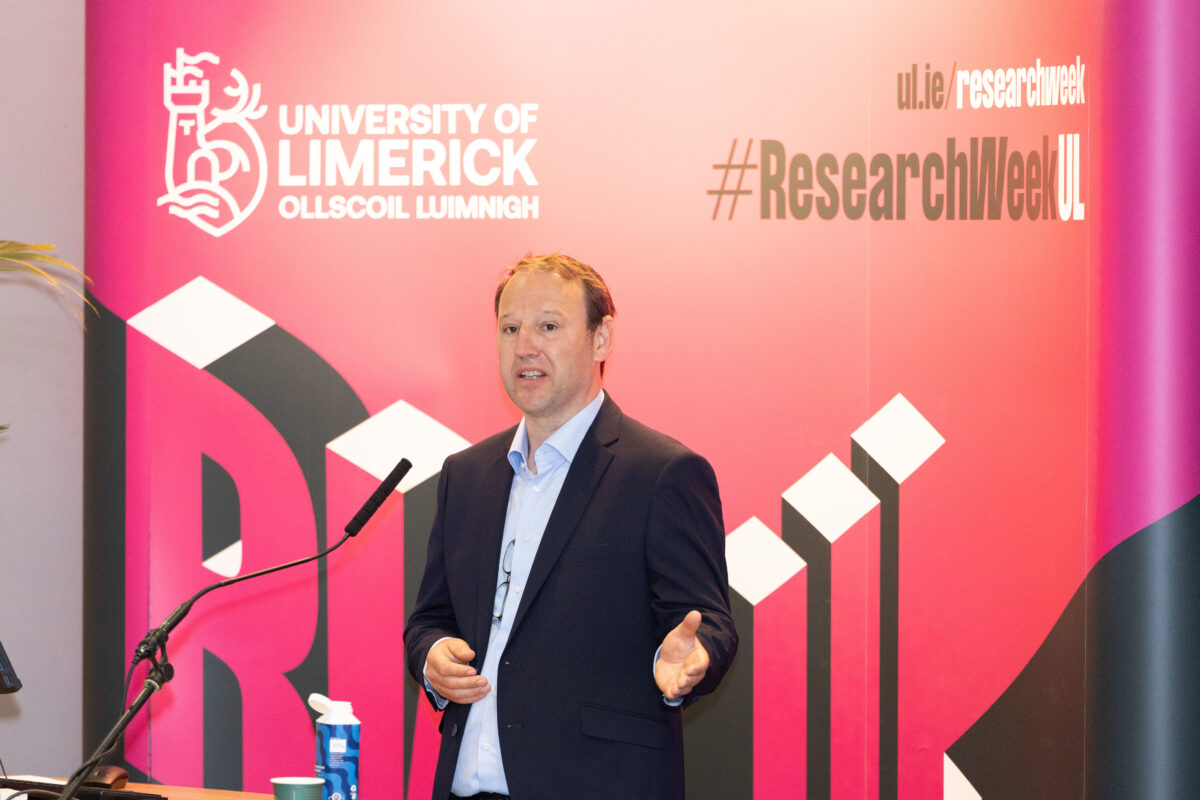
University of Limerick (UL) is committed to the responsible, ethical, and evidence-informed AI use. UL has established an AI Taskforce chaired by the Provost Professor Ann Ledwithand Associate Professor Máirtín Cunneen (a leading scholar in AI Governance) that brings together expertise across the institution and faculties to assess, guide, and support the responsible use of AI, including generative AI, across the institution. The goal of the AI Taskforce is to clear away uncertainty and establish a responsible and ethical AI future for the University of Limerick, its staff, students and researchers.
In December 2025, the Higher Education Authority, which has statutory responsibility for the effective governance and regulation of the higher education system in Ireland, published a national Generative AI in Higher Education Teaching and Learning Policy framework and Generative AI in Higher Education Teaching and Learning Principles for Ethical AI Adoption, emphasising the need for ethical and responsible adoption.
Aligning with this focus, UL has already taken steps to support responsible AI adoption through initiatives such as ‘Let’s Talk About Gen-AI’ training and the approval of Microsoft Copilot within the University’s Microsoft 365 environment.
This provides the UL community with access to safer Generative-AI functionality, both standalone, and within familiar applications, subject to university policies and appropriate use guidance. Currently, Microsoft Copilot is the only approved Generative AI tool, and this ensures prompt and response protection. UL is eager to leverage further AI tools to support AI fluency and informed use.
The UL AI Taskforce is already working on the next phase of the University’s approach to AI innovation, governance, and responsible adoption. This work will include exploring the safe and responsible use of additional AI models, developing guidance for staff and students, building AI literacy and increased fluency across the institution, and assessing the infrastructure required to support research and innovation, as we shape our evidenced based approach to leveraging the opportunities, while managing the challenges presented by AI.
University of Potsdam
The University of Potsdam has been engaging systematically with artificial intelligence in research and teaching for several years. As early as November 2023, it laid the groundwork with the position paper “AI in Teaching,” which promotes an active, reflective, and critical approach to generative AI in higher education. Since then, this approach has been continuously developed further, including through practice-oriented guidance on handling AI in examinations. This is complemented by the “UPdate.KI” event series, which offers monthly institutional perspectives and practical insights into the use of AI in teaching, keeping instructors continuously up to date. In the 2024/25 winter semester, the University of Potsdam also launched the new ‘GPT.UP’ service, which enables all members of the university community to work with an AI-powered chat assistant.

The topic is also firmly embedded structurally: the international master’s program “Cognitive Systems” establishes AI themes across disciplines, spanning the natural and human sciences. In addition, a interdisciplinary professorship for “Artificial Intelligence in the Sciences” is focusing on AI applications in the natural and cognitive sciences. The Collaborative Research Center “Data Assimilation” (SFB 1294) also plays an important role, investigating the integration of data and scientific models in fields such as cognitive neuroscience, biophysics, and earth sciences — an area closely intertwined with machine learning and AI methods. This focus is reinforced by close cooperation with the Hasso Plattner Institute (HPI): through the jointly run Digital Engineering Faculty, AI expertise from computer science flows directly into study programs and research.
Beyond this, the university hosts numerous further research projects and groups applying AI across a wide range of disciplines — from computational linguistics to educational science to digital health and data science. All of this shows that AI is no longer a marginal topic at the University of Potsdam, but shapes both the strategic direction of teaching and a broad spectrum of research activities.
https://www.uni-potsdam.de/en/university-of-potsdam
University of Bremen

From August 15 to 21, 2026, Bremen will host the 35th International Joint Conference on Artificial Intelligence (IJCAI), organized jointly with the European Artificial Intelligence Association as IJCAI-ECAI 2026. IJCAI plays a pivotal role in showcasing the frontiers of artificial intelligence research and applications, representing the oldest continuously running conference on artificial intelligence.
The Local Arrangement Committee’s efforts in 2026 are supported by three organizations: the U Bremen Research Alliance (UBRA), the German Research Center for Artificial Intelligence (DFKI), and the German Informatics Society (GI).
IJCAI typically attracts over 3,000 participants and brings together leading technical researchers, university experts, and industry professionals from around the world.
AI Research in Bremen
In the international competition to host the world’s leading conference on artificial intelligence, Bremen prevailed over significantly larger locations. The decisive factor was a comprehensive package rarely seen in this form, including outstanding research, well-established knowledge transfer structures, and an AI strategy developed early on and implemented consistently.
At the core of Bremen’s academic AI ecosystem is the University of Bremen, with its interdisciplinary research area of focus “Minds, Media, Machines.” This network brings together around 400 researchers from eight faculties and advances research in areas such as robotics, machine learning, data science, social media, and mobile communication. AI research is also particularly successful in attracting competitive third-party funding.
Collaboration across institutions is a defining feature of Bremen’s AI ecosystem. The University of Bremen and thirteen federally and state-financed non-university research institutes collaborate within the U Bremen Research Alliance. These activities emphasize the development of trustworthy AI, including reliability, usability, privacy, and sustainability.
With IJCAI-ECAI 2026, Bremen will showcase these strengths on a global scale. Alongside the conference, a “Summer of AI” is planned to connect academia, industry, and society, making AI more tangible and accessible.
University of Antwerp
Artificial Intelligence is reshaping the way universities conduct research, educate students and organise their daily operations. At the University of Antwerp, we see AI as an opportunity to strengthen our core missions, while ensuring that innovation goes hand in hand with responsibility.

AI is already making an impact across a wide range of research domains. From developing new healthcare applications and analysing large biomedical datasets to advancing language technologies, sustainability research and digital humanities, researchers increasingly rely on AI to accelerate scientific discovery and tackle complex societal challenges.
At the same time, the University of Antwerp is helping shape the future of trustworthy AI. Through the Antwerp Centre on Responsible AI (ACRAI), legal scholars, philosophers, computer scientists, social scientists and other experts work together on questions surrounding transparency, fairness, accountability and the societal impact of AI. This interdisciplinary approach reflects the university’s conviction that AI is not only a technological challenge, but also a human one.
Education is evolving as well. Rather than banning generative AI, the university equips lecturers and students to use it critically and responsibly. Researchers have developed practical guidance on “AI-proofing” assessments, redesigning assignments where needed while also identifying opportunities to integrate AI into learning in meaningful ways. In parallel, university-wide guidelines support the responsible use of AI in research, emphasisingthat researchers remain accountable for the quality and integrity of their work.
AI is also finding its way into administrative services, where new applications are explored to improve efficiency and user experience. Throughout these developments, privacy, ethics and academic integrity remain guiding principles.
For the University of Antwerp, AI is more than a new tool. It is an opportunity to combine technological innovation with critical thinking, interdisciplinary collaboration and societal impact.
University of Konstanz
Understanding how misinformation spreads and how it affects democracy has become an increasingly important challenge. Social media and mass media have fundamentally transformed the way information spreads in society, contributing to a decline in the quality of the information we receive.
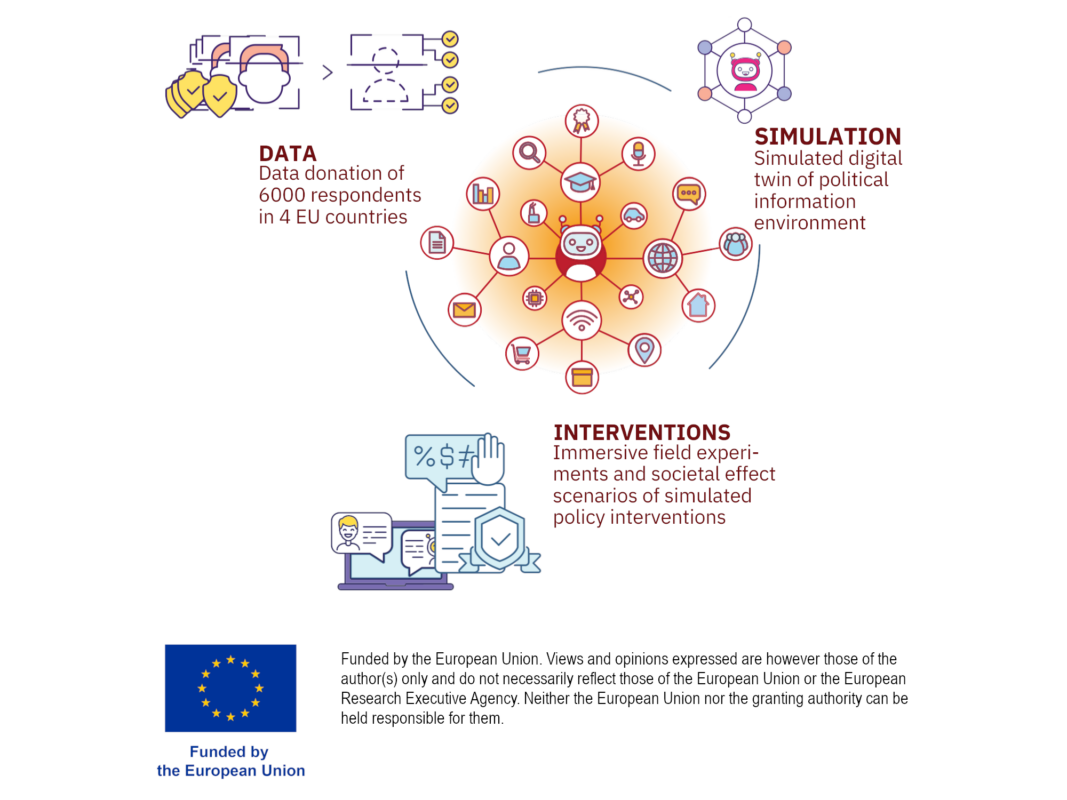
So, what if we could trace how misinformation flows, measure its impact, and design policies to mitigate its effects before they materialise? This question is at the core of WHAT-IF – a research project funded by the European Union’s Horizon Europe programme (grant agreement No 101177574), coordinated by the Vrije Universiteit Amsterdam (Netherlands)and involving the working group of David Garcia, Professor of Social and Behavioural Data Science at the University of Konstanz. Within the WHAT-IF project, he leads the work package “Agent-based modelling and simulation”.
At its core, WHAT-IF is developing a unique, ai-driven digital simulation of today’s political information environment. This simulation will function as a “digital twin” of the online world, designed to help researchers explore how information spreads, how people engage with political content, and which challenges arise from disinformation, hate speech, and growing polarization. Crucially, it will enable researchers to anticipate and evaluate how different policies and regulatory interventions might shape the digital public sphere.
To build this simulation, the project combines a data donation platform – developed by the researchers to collect online data – with advanced computational models and artificial intelligence to recreate key aspects of the digital information landscape. The resulting “WHAT-IF machine” allows researchers to test different scenarios and analyse what might happen if new media regulations or policy measures were introduced. Policymakers, citizens, and other stakeholders are actively involved in the project to ensure that the research addresses real-world needs and concerns.
Contact: David Garcia, Professor of Social and Behavioural Data Science, Department of Politics and Public Administration and Cluster of Excellence “The Politics of Inequality”, University of Konstanz
Nicolaus Copernicus University in Toruń
“Our guiding principle is always HUMAN in the loop – people must remain at the centre of all AI-related actions and solutions,” says Dr Łukasz Wojtkowski, Head of the Artificial Intelligence Team at Nicolaus Copernicus University (NCU).

Established in June 2026, the team brings together experts from various fields,representing both academic and administrative perspectives. Developing a comprehensive approach to the use of AI across research, education and university administration are the group’s main tasks.
The team’s work focuses on understanding and responding to the needs of key university communities: scientists conducting AI-based research or using AI in their work, administrative staff, and students developing their competences. Through NCU’s involvement in YERUN and participation in the network’s AI in Teaching and Learning Task Force, the university follows the European Commission’s discussions and priorities related to responsible AI adoption, supporting technological development and access to national and European infrastructures.
The team’s first step will be a university-wide mapping process, identifying already used AI tools, ongoing research activities, data storage practices and the specific requirements of different user groups.
“Building on the results of the mapping, our focus will be on developing and implementing an effective AI policy, which is a challenging task in a complex and diverse institution like ours. The main goal is to create a practical framework that will organise our activities, provide guidance and identify reliable tools that can genuinely support the entire university community,” explains Dr Wojtkowski.
Through this strategic approach, NCU aims to ensure that AI serves as a tool for enhancing research excellence, learning experiences and administrative processes, while keeping human expertise and responsibility at the core.
University of Eastern Finland
The University of Eastern Finland (UEF) is advancing artificial intelligence across research, education and services through a coordinated, institution-wide approach.

As a first step, the university has introduced the UEF AI Assistant, an internal conversational AI service for staff. It runs in a secure, closed environment that allows confidential material to be processed safely. Staff can use the AI assistant to draft and refine texts, develop ideas and structure and analyse information. The service also supports document analysis, image creation and interpretation, audio and video transcription in over 100 languages, custom AI assistants for specific projects, shared collaborative conversations, and a model router that directs lighter tasks to energy-efficient AI models.
To guide responsible use, UEF has established a university-wide AI policy and implemented requirements arising from the EU AI Act, including the procurement, assessment and registration of AI services. AI literacy training has been rolled out across the organisation and made mandatory for all staff.
In education, UEF has launched a strategic development project spanning several areas, including pedagogical methods for using AI in education and the piloting of AI solutions and agents. AI-enabled services are also being tested and used in university processes such as study counselling and more efficient handling of service-desk requests.
Peer support comes through the newly launched AI Champion network which includesenthusiastic colleagues, not technical experts, who help their units adopt AI tools as part of a multi-level support model. Internal AI communities and networks further strengthen shared learning.
Finally, the university has commissioned a study on how UEF could position and distinguish itself as a future user of AI in education, research and services, forming the basis for strategic AI decisions within the UEF strategy process.
Maastricht University
Artificial intelligence has been part of the academic landscape at Maastricht University since 1992. That year, the university launched the Knowledge Engineering programme, which would become the foundation for today’s Bachelor’s programme in Data Science and Artificial Intelligence. Machine learning formed a core part of the curriculum from the outset, establishing it as one of the first AI degree programmes in the Netherlands.

Naturally, much has changed since then, both in the digital world and at UM. Today, AI is integrated into several of our degree programmes. Take the Bachelor’s programmes in Data Science and Artificial Intelligence, Computer Science, and Digital Society, for example. There is also a wide range of Master’s programmes: Artificial Intelligence; Law & AI; Crop Biotechnology and Engineering; Data Science for Decision Making; Digital Business and Economics; Health and Digital Transformation; Imaging Engineering; Media Studies –Digital Cultures; and Responsible Data Science.
As well as readying our students and teachers for the world of AI, we interact with the technology to enhance the quality of our teaching and learning. We put this into practice at EDLAB, the Centre for Teaching & Learning at Maastricht University. Through the process of knowledge transfer and training. But likewise with education research, for instance with a current project that explores how AI and broader societal shifts will shape the future of learning at Maastricht University. The University Library also plays a prominent role in online and on-site knowledge transfer and training. A noteworthy showcase is the AI Prompt Library, a collection of prompt templates designed to inspire the professional engagement with AI tools.
Across multiple faculties, departments and research groups, our researchers are diving into AI from a wide range of perspectives. These include the Institute of Data Science and the Department of Advanced Computing Sciences in our Faculty of Science and Engineering, which are pioneering work on AI models for healthcare; the Law Tech Lab in our Faculty of Law, which examines AI in medical decision making processes; the Department of Marketing and Supply Chain Management in the School of Business and Economics, which explores AI in the context of Maastricht University’s Problem-Based Learning; and the interdisciplinary research programmes in the Faculty of Arts and Social Sciences, which investigate AI’s role in governance, policy and culture. Additionally, UM researchers have recently been selected for the European AI in Science Working Groups, an important pan-European initiative designed to accelerate AI-driven discovery.
We are also proud of our innovative digital technology research and our collaborative labs: SwarmLab, the Law and Tech Lab, DEXLab and The Plant. AI comes here to practice with workshops, research and also to participation in the current Erasmus+ project ‘Assisting Teaching and Learning with AI-based Solutions’.
From the natural sciences to the social sciences and humanities, almost all of Maastricht University’s organisation components are actively engaging with AI. At the heart of our approach lies one guiding principle: AI should serve people and society. This is why we invest not only in the application of AI, but also in its responsible and ethical use, as set out in our GenAI guidelines and policies and the Responsible Use of GenAI principles.