The Young European Research Universities Network (YERUN) welcomes the presentation of the European Commission’s (EC) proposal for the Multiannual Financial Framework (MFF) 2028-2034. This proposal sets out the direction for the European Union’s (EU) long-term budget and will shape the development of key funding instruments, including the 10th Framework Programme for Research and Innovation (FP10), the European Competitiveness Fund (ECF) and Erasmus. YERUN acknowledges the EC’s focus on strengthening the EU’s competitiveness and capacity to address global challenges through knowledge and innovation.
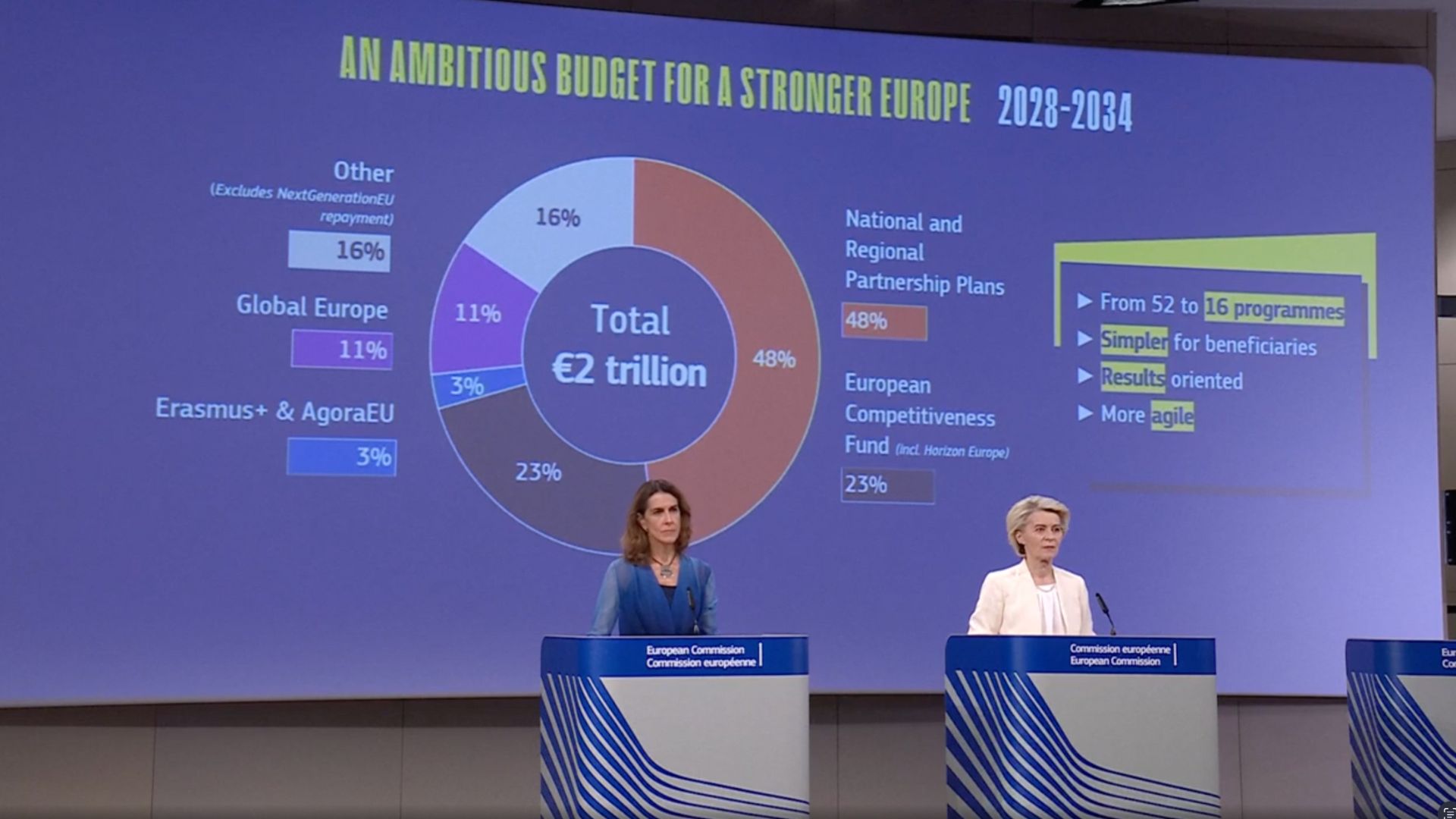
YERUN celebrates the unprecedented total MFF envelope of EUR 2 trillion (in current prices) announced yesterday by the EC, of which EUR 451 billion (23%) is earmarked for the ECF. Research and innovation (R&I) remain at the core of the EU’s investment strategy, and YERUN welcomes the proposed EUR 175 billion budget for FP10, the highest ever for the R&I EU funding programme. This investment sends a strong signal of the EU’s commitment to research, talent, and innovation as essential drivers of European competitiveness and global leadership. The next FP can be a key driver of European competitiveness and operationalise the EU’s strategic ambitions.
In this context, YERUN provides the following initial reflections in light of the budgetary and structural proposals set out by the EC regarding FP10, ECF and Erasmus:
YERUN’s initial considerations on key MFF elements: FP10, ECF and Erasmus
- FP10 is legally independent but practically interdependent with the ECF
YERUN notes the continued emphasis on R&I as a central pillar of Europe’s future prosperity. The commitment for an independent EU research funding programme, with strong support for bottom-up funding instruments, reflects a welcome continuity that ensures Europe’s scientific excellence and attractiveness for global talent. YERUN welcomes the continued support for the European Research Council (ERC) and the Marie Skłodowska-Curie Actions (MSCA) as key pillars of excellence and talent development in Europe (EUR 44 billion -25.19% of total FP proposed budget-, allocated for Pillar I ‘Excellent Science’). Nonetheless, YERUN reiterates that directionality in MSCA may put at risk the strengths that have made the programme successful and attractive to early-career researchers across Europe. Ensuring its openness and bottom-up character must remain a priority.
At the same time, the close association between FP10 and the new ECF in the policy windows (which include Clean Transition and Industrial Decarbonisation, Health, Biotech, Agriculture and Bioeconomy, Digital Leadership, and Resilience Security Defense and Space), risks blurring the lines between strategic industrial objectives and independent, excellence-based research. While the connection between R&I and deployment in strategic areas is important, YERUN stresses that such efforts must not compromise the distinct role of the FP10 in supporting excellence, openness and collaboration in research. It is essential to maintain a clear division of purpose, structure and governance between the ECF, FP10 and other investment tools. We remain cautious with the proposed alignment with the ECF as it may create uncertainty regarding the future direction and scope of the EU’s research collaborative funding. FP10 should continue to be shaped by the research community, guided by scientific quality and societal relevance.
Given the new interlinked structure of the new MFF, an important feature of the new governance framework will be the proposed Competitiveness Coordination Tool (CCT). Designed to align industrial and research policies and investments at both EU and national levels, the CCT aims to enhance synergies between FP10, the ECF, the Innovation Fund and other MFF instruments.
While coordination will be key and necessary, YERUN stresses the importance of ensuring that FP10remains focused on building a strong, inclusive and sustainable knowledge base. That requires robust support for fundamental and early-stage collaborative research, as well as for open science, early-career researchers and cross-border institutional cooperation. Funding must be shaped by long-term scientific and societal priorities, not only short-term economic or strategic imperatives.
- A redefined role for collaborative research
A renewed Pillar II, entitled “Competitiveness and Society”, retains the core of collaborative research within FP10. However, it introduces an artificial division between a “competitiveness” component, closely linked to the ECF, and a “society” component, which includes research on global societal challenges, EU missions and the New European Bauhaus initiative.
The contribution of disciplines such as the social sciences and humanities remains essential for addressing complex societal challenges and achieving inclusive innovation and competitiveness. The ‘Society’ component, currently accounts for only 4.35% of the total proposed FP10 budget. Greater funding for the ‘Society’ component will be necessary.
The confirmation that FP10 will cover the R&I dimension of both EU missions and the New European Bauhaus initiative within this architecture is welcome. These initiatives offer valuable platforms for cross-sectoral and citizen-engaged research.
YERUN further welcomes a strategic and coherent portfolio of a limited number of Partnerships and welcomes the proposal for a transparent and inclusive approach to their design and governance, ensuring broad accessibility and avoiding the over-concentration of funding among a limited number of actors.
- Simplification measures: an opportunity with careful implementation
The EC’s intention to simplify access to EU funding is a welcome step toward enhancing the attractiveness and inclusiveness of the R&I framework. The proposed reduction in time-to-grant periods and a streamlined call structure are among the notable features under consideration. A use of lump sun funding as default mechanism may require further examination.
Furthermore, YERUN welcomes the move towards reduced prescriptiveness in the next R&I Programme, as reflected in a more streamlined work programme design. The proposed reduction in the number of topics, shorter topic descriptions, and the minimisation of single-project calls are positive steps toward greater flexibility and efficiency in research funding. In particular, the introduction of open topics by default is a promising development, offering applicants more freedom to propose innovative approaches and diverse pathways toward achieving expected outcomes. This shift aligns with the need to foster bottom-up excellence and enable the research community to respond creatively to emerging scientific and societal challenges.
YERUN also supports efforts that can reduce administrative burden, particularly for institutions with fewer resources and to broaden participation in EU programmes. At the same time, it will be important to maintain stability and monitor the implementation of these measures to ensure that they support the participation of diverse actors. Flexibility in funding formats and clarity in evaluation criteria will be key to ensuring fairness and transparency across the programme. The proposed move away from strict project typologies and toward more outcome-based calls might allow greater room for innovation and interdisciplinary approaches. However, its success will depend on providing adequate guidance to applicants and ensuring that expected outcomes are inclusive of diverse disciplines and not narrowly centred on economic competitiveness.
- Recognising the role of universities in the R&I ecosystem
The evolving structure of the MFF and the proposed alignment between FP10 and the ECF present a valuable opportunity to emphasise the broader contribution of universities to the EU’s innovation and skills agenda. This includes their key role in shaping and driving ecosystems that integrate knowledge, research, and innovation. While the ECF includes references to investment in strategic technologies and skills, the broader contribution of universities, through research, education, training and civic engagement, deserves greater consideration.
YERUN underlines the importance of recognising universities as integral actors in the innovation ecosystem. Their role extends beyond research and includes educating future talent, fostering regional development and contributing to social and democratic health. Strengthening synergies between the research and education missions of universities will be key to delivering on the EU’s strategic ambitions. YERUN reaffirms the value of sustained investment in both education and research, as mutually reinforcing pillars of Europe’s future competitiveness.
- Spreading excellence and supporting widening participation with targeted measures
YERUN supports the efforts to reinforce the European Research Area (ERA) under Pillar IV. This component will support the development and operation of research and technology infrastructures, strengthening the knowledge triangle between education, research, and innovation.
Similarly, YERUN welcomes the increased resources allocated to widening participation and notes the introduction of a new “transition countries” category in the FP10 widening measures, which aims to address participation imbalances and support countries with growing research capacities. This addition could tailor support more effectively across different contexts. YERUN highlights the importance of continued and well-resourced widening actions. These should include support for institutional capacity building, collaborative networks, talent retention and mobility, and measures to counteract brain drain. A strong and inclusive European Research Area (ERA) will depend on the ability of FP10 to foster excellence and opportunity across all member states and associated countries.
- A Shift Toward Skills, Gaps and Shortages in EU funding for Education
YERUN recognises the strong focus on advancing the Union of Skills and the clear need to upskill and reskill citizens across Europe. Universities have already been, and continue to be, ready to play a central role in this effort. We support the emphasis on collaboration between universities, VET providers, SMEs, social partners, and other sectors. However, it is essential that institutions retain the autonomy to select the key actors that will bring added value to their partnerships and decide how and with whom they engage.
On Erasmus, the picture is still developing. A 50% increase (€40.8bn ringfenced) in the budget is certainly welcome, but falls below the three fold increase previously called for. However, the proposal includes a significant number of new activities and targets, and it remains to be seen whether the proposed resources will be sufficient to meet these expanded ambitions, especially when inflation means that the 2025 value of the €26bn in 2021 is worth €31bn in today’s money.
In addition, from what we know at this moment, the European Social Fund will support education reforms, investments and quality, and the European Competitiveness Fund will also be able to support quality in lifelong learning, skills, and education. We will follow the developments in these funding opportunities and see how they can enhance educational offerings in our member institutions.
Conclusion
YERUN remains committed to constructive engagement with the EU institutions and stakeholders throughout the negotiations on the MFF, and more concretely on FP10, Erasmus and the ECF. As discussions progress, we encourage decision-makers to consider the following priorities: maintain the core mission of FP10 as an excellence-based, collaborative and inclusive research programme; ensure clear and distinct governance between FP10 and other instruments such as the ECF; ensure sufficient resources for societal challenges; reflect the full role of universities in Europe’s research, innovation and skills strategies; implement simplification measures that support transparency, quality and wider participation; and sustain and strengthen support for widening participation through tailored and well-funded initiatives.
The next MFF will shape the scope and ambition of Europe’s knowledge ecosystem for years to come. YERUN stands ready to support a future-oriented R&I landscape that reflects Europe’s diversity, talent, and shared commitment to scientific and societal progress.