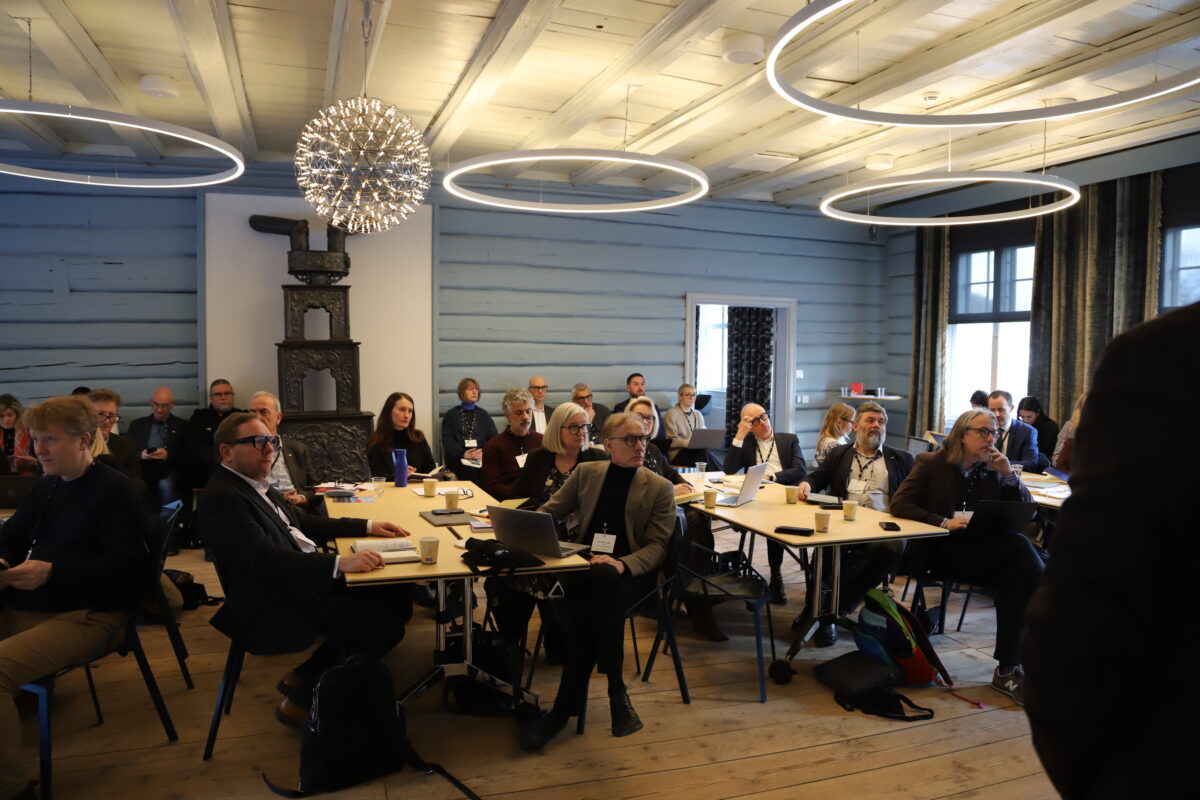
From 17 to 19 March 2026, YERUN members gathered in Kongsberg, Norway, for the YERUN General Assembly, hosted by the University of South-Eastern Norway (USN). A central moment of the General Assembly was the Leaders’ Workshop on dual-use and defence in the context of the next EU Framework Programme (FP10), addressing the growing integration of security and defence considerations into European research and innovation policy.
The workshop brought together perspectives from policy, industry and academia. Niall Lawlor, Policy Officer at the European Commission (DG RTD), outlined the latest developments on dual-use in FP10 and the European Competitiveness Fund (ECF), including the current “dual-use by design” approach. Dr Ellen Tuset, Vice President Common Technologies at Kongsberg Discovery, highlighted the growing role of cross-sector innovation and the importance of export control regulations and structured processes in industry collaboration. The academic and researchers’ perspective was further explored by Associate Professor Elisabet Syverud, Dean at USN, and Professor Einar Halvorsen. Dean Syverud provided an insightful overview of how dual-use research is conducted at USN, including collaboration with industry actors and concrete examples from their institutional practice. Professor Halvorsen reflected on the challenges faced by researchers, including issues related to collaboration, knowledge exchange, researcher responsibility and the need for stronger institutional support and training.
The second part of the workshop focused on an open exchange among YERUN leaders, revealing a complex and evolving landscape for universities. A key takeaway was the diversity of institutional approaches. While some universities are exploring more proactive engagement, others remain cautious due to national frameworks, institutional values or historical positions. These developments have triggered internal reflection on the role of universities and their association with defence-related activities.
Across the discussion, leaders highlighted a key tension between maintaining the civilian character of comprehensive research and responding to growing expectations around security, defence and competitiveness. Universities are increasingly balancing openness and academic freedom with research security requirements, while also addressing student perceptions and societal expectations.
A recurring discussion was that dual-use is inherently difficult to define in practice, beyond the existing European and national export control frameworks. Rather than a clear delineation, it represents a “grey zone” for comprehensive universities, where civilian research may evolve towards defence applications. This complicates governance, as risks often emerge downstream, making them difficult to assess at the outset of projects and proposals.
In response, universities are developing new governance models and support structures, including ethical committees, security boards, training programmes and internal guidelines, although approaches remain uneven across institutions and countries. At the same time, growing attention to research security, critical infrastructures and sensitive technologies, such as AI, quantum and drones, is leading universities to reassess international collaboration, particularly with strategic partners.
While these developments present challenges, they also create opportunities. Dual-use research may open new avenues for collaboration with industry, contribute to societal resilience and strengthen Europe’s innovation capacity, provided that clear conditions, appropriate safeguards and institutional readiness are in place.
Looking ahead, there was strong consensus on the need for clearer EU-level frameworks and guidance, as well as continued exchange of practices among YERUN members. As universities enter a new phase marked by increasing complexity in balancing values, collaboration and security considerations, YERUN Leaders emphasised that institutions cannot address these challenges alone. Collective reflection and coordination through our network will be essential as YERUN universities define their approaches to dual-use in a way that remains aligned with their core missions and a primarily civilian orientation.
These discussions also set the foundation for the launch of a dedicated YERUN ad hoc Group on Dual-Use, Defence and Security, which will serve as a platform for continued exchange, the development of shared approaches and the articulation of common positions. Through this initiative, YERUN aims to support its members in navigating this evolving landscape while contributing to ongoing European discussions on the future of dual-use research and its role within FP10 and other funding programmes.